How to Choose the Right Eyeglass Frame Shape
Compare eyeglass frame shapes, explore face-shape styling ideas and build a shortlist with GRAEL's visual guide to curves, angles and fit.
8 min read · Published October 17, 2026
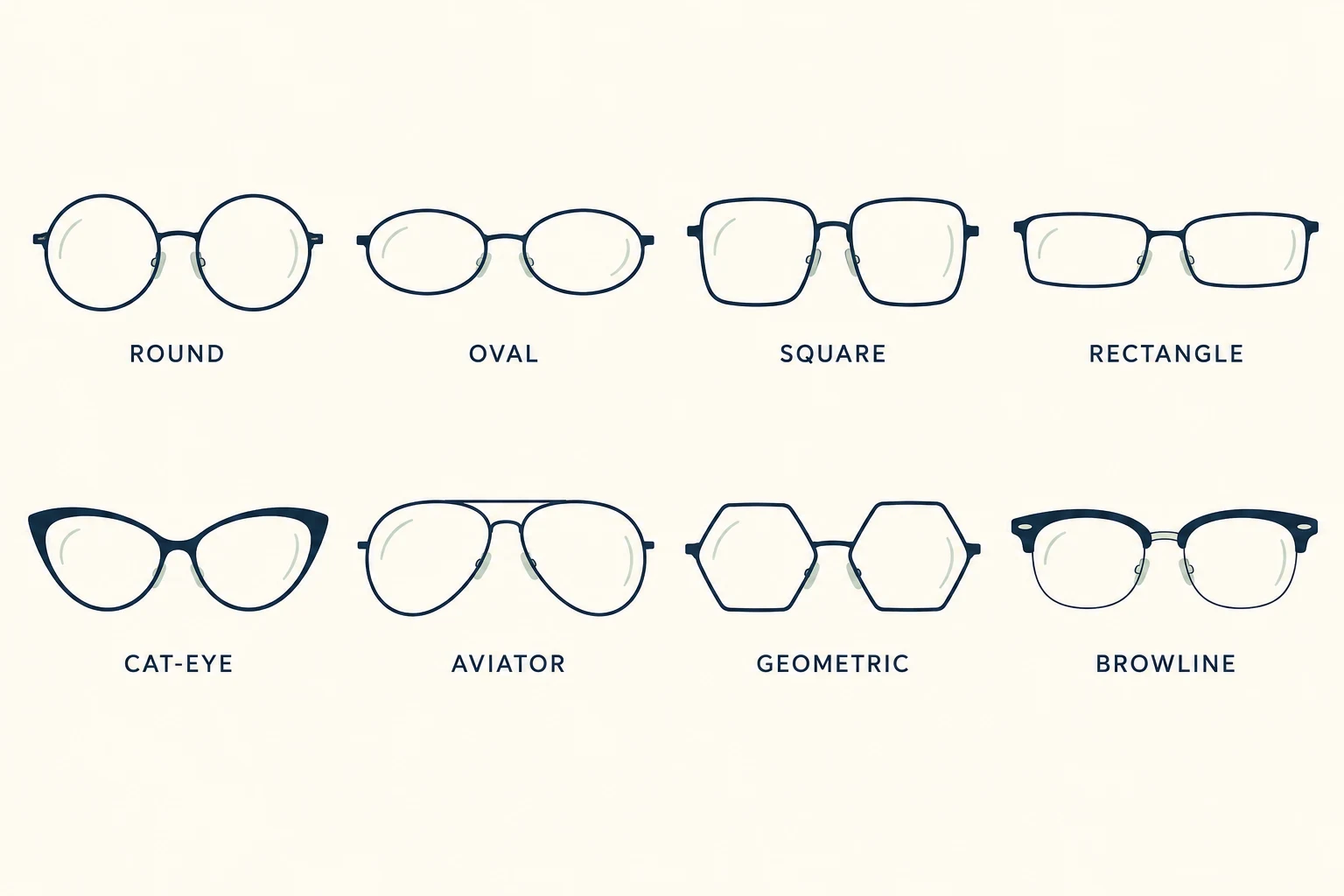
Finding your next pair starts with a simple question: do you prefer soft curves, clean angles or an upswept outline? Eyeglass frame shapes describe the front silhouette of the glasses. Learning those names makes it easier to compare styles without guessing what a catalogue label means.
Start with a shape you like, then check its width, bridge and overall fit. Face-shape advice can suggest something new to try, but it cannot tell you whether a particular pair will feel comfortable or suit your preferences.
At a glance
- Round and oval frames bring curves; square and rectangular frames bring stronger angles.
- Cat-eye, aviator and geometric styles have more distinctive outlines.
- Browline describes an emphasized upper rim; rimless describes construction, not a lens shape.
- Use face shape as inspiration, then compare actual frame proportions and fit.
What are the main eyeglass frame shapes?
The main families are round, oval, square, rectangular, cat-eye, aviator and geometric. Styles overlap: a frame can be a rounded square, a softly upswept oval or a geometric take on an aviator. Look at the front-view photograph as well as the name.
Illustrated shape reference, created with AI. These are generic examples, not photographs of GRAEL products. Browline is included as a styling category rather than a separate lens geometry.
| Style | How to recognize it | A useful comparison |
|---|---|---|
| Round | Circular or nearly circular lens openings | Compare with oval for a less circular look |
| Oval | Curved lens openings stretched horizontally | Compare with rounded rectangle for more structure |
| Square | Similar-looking height and width, with visible corners | Compare with rectangle for a shallower outline |
| Rectangle | Wider than tall, with straighter upper and lower edges | Compare with square for more lens depth |
| Cat-eye | Outer corners rise toward the temples | Compare subtle and dramatic versions |
| Aviator | Usually a teardrop outline, often with a double bridge | Compare with rounded-square double-bridge frames |
| Geometric | Visible facets, such as six or eight sides | Compare thin and thick rims around the same outline |
| Browline | A heavier upper rim and lighter-looking lower edge | Check the underlying lens shape too |
Round frames
Round glasses draw attention to curves. A fine metal rim can look understated, while a thick acetate rim makes the same circular shape more prominent. Small changes at the bridge and outer edge can also make two round frames feel quite different.
Try round frames if you want a softer outline or enjoy a classic circular look. If a near-perfect circle feels too strong, compare a rounded shape with a slightly flatter top. Neither version is restricted to a particular gender or face type.
Oval frames
Oval glasses have a continuous curve with more width than height. They usually look less circular than round frames, and they can be a useful starting point when you want curves without much vertical depth.
Compare the entire silhouette rather than the label alone. A slim oval and a deep, chunky oval can create very different impressions. Check that the lower edge clears your cheeks when you smile during a fitting.
Square and rectangular frames
Square glasses have a more balanced-looking height and width; rectangles stretch further horizontally. Both can have sharp corners or softer, rounded edges. A rounded square is worth comparing if you want definition without a strongly angular outline.
For an understated look, compare thinner rims or lighter colours. For more emphasis, compare bolder rims in a similar size. Avoid assuming that every rectangle is narrow-fitting: the shape name says nothing reliable about its actual width.
Cat-eye frames
Cat-eye glasses rise at the outer corners. Some have a gentle upward sweep; others extend into a pronounced point. That change in the top line can be more noticeable than a change in colour.
Start with a subtle cat-eye if you are unsure about the shape. Then compare a more dramatic version at a similar width. Cat-eye is a style choice for anyone who likes an upswept outline, rather than a rule about who should wear it.
Aviator frames
Aviators traditionally combine a rounded teardrop outline with a bridge and an additional upper bar. Optical versions can use clear lenses, and modern interpretations may be squarer or less deeply curved.
Check how much space the lower lens area occupies on your face. Also compare the bridge and upper bar in a front view. A double bridge alone does not make a frame an aviator; the overall silhouette matters.
Geometric frames
Geometric glasses use visible corners or facets, such as hexagons and octagons. A thin rim can keep the effect subtle, while a thicker rim makes those edges more obvious. Some shapes combine a curved bottom with an angular top.
Try them when you want a clear difference from a familiar round or rectangular pair. Compare a front-view photograph with an angled view so you can distinguish the lens outline from decorative details at the hinges.
Browline and rimless styles
Browline frames emphasize the upper rim. The lens beneath it may be rounded, square or rectangular. Rimless frames have no surrounding rim, while semi-rimless frames support only part of the lens edge.
These terms describe how the frame looks or is built, rather than a single lens shape. A rimless rectangle is still rectangular. When browsing, consider shape, rim construction and material separately; each answers a different question.
Which frame shapes might complement your face?
Use face-shape pairings to explore contrast, not to eliminate styles. Rounded frames can contrast with angular features, while angular frames can contrast with softer features. You may also prefer to repeat your natural lines instead of contrasting them.
Specsavers’ face-shape guide uses this contrast approach for round and square faces. Warby Parker also emphasizes that face-shape guidance is flexible. The suggestions below are starting points for comparison, not promises about appearance or fit.
| If your features feel closer to… | Compare these first | What to look for |
|---|---|---|
| Round: softer curves and similar overall width and length | Rectangle, square or a gentle cat-eye | Whether straighter lines give the contrast you want |
| Square: a more angular jaw and broad forehead | Round, oval or rounded square | Whether curved edges soften the overall outline |
| Oval: greater length than width with softer contours | Several shapes at a comparable width | Which proportions and top line you enjoy most |
| Heart: a broader forehead and narrower chin | Oval, rounded square or a fine-rim aviator | How visually heavy the upper part of the frame feels |
| Triangle: a broader jaw and narrower forehead | Browline or cat-eye | Whether an emphasized upper line feels balanced to you |
| Diamond: prominent cheekbones and a narrower forehead and chin | Oval, gentle cat-eye or browline | How the frame sits near the cheeks and outer corners |
| Oblong: noticeably longer than wide | Deeper round, square or geometric styles | Whether extra lens depth gives the proportions you prefer |
Most faces do not fit neatly into one category. You do not need an exact label to compare glasses. Try describing the effect you want instead: more angular, more curved, less prominent or more expressive.
Why can the same shape look so different?
Shape is only one part of a frame’s appearance. Rim thickness, colour, lens depth and bridge design all change what you notice first. Compare these features one at a time to understand why one pair appeals to you more than another.
- Rim thickness: compare a fine outline with a heavier outline before deciding you dislike the shape itself.
- Colour: compare black, clear and tortoiseshell versions where available. Read our guide to clear, black and tortoiseshell glasses.
- Lens depth: look at how far the frame extends below the eyes, not just its width.
- Bridge: compare the visible bridge shape and how the frame rests on your nose during a fitting.
- Material and construction: use our acetate, metal and TR90 guide to understand the labels without treating material as a guarantee of comfort.
For example, compare two rounded squares with similar dimensions but different rim thicknesses. That is a more useful test of your preference than comparing a small metal round with a large acetate rectangle, where several features change at once.
How do you check fit after choosing a shape?
A favourite silhouette still needs a suitable fit. Compare the measurements with a pair that already fits reasonably well, then have an optician assess the actual frame. A photograph or face-shape category cannot confirm comfort, stability or lens suitability.
Use our glasses frame measurements guide to understand lens width, bridge width and temple length. Those numbers help you shortlist options, but matching numbers do not guarantee an identical fit across different designs.
During a fitting, notice whether the frame slides, presses at your temples, sits unevenly or touches your cheeks when you smile. Tell the optician what you feel rather than trying to correct the frame yourself. Ask whether the chosen frame works with your prescription and intended lenses.
Keep style and fit as two separate checks. “I like this shape” is a good reason to shortlist a frame. “This frame fits me” needs an assessment of the actual pair.
Build a frame-shape shortlist on GRAEL
Start with three candidates: one familiar shape, one nearby alternative and one style you would not normally try. Keep colour and overall proportions similar when possible. This gives you a clear comparison without turning the search into a long list of unrelated pairs.
- Open GRAEL’s frame catalogue and expand the Shape filter.
- Choose a shape you already like, then compare a related option using the product photographs.
- Check the frame details and colour options before adding it to your personal shortlist.
- Join a frame’s waitlist if you would like availability updates.
GRAEL is an independent eyewear retailer based in British Columbia. The catalogue is currently for preview and interest collection; frames are not available to buy yet. Joining a waitlist involves no payment or purchase commitment and does not guarantee availability or a reservation.
You do not have to settle on one shape today. The useful outcome is knowing what to compare next, whether that is a softer corner, a finer rim or a different bridge.
Questions about eyeglass frame shapes
What is the difference between round and oval glasses?
Round glasses have circular or nearly circular lens openings. Oval glasses are stretched horizontally. The distinction can be subtle, so compare the front view rather than relying only on the product label.
Are square and rectangular glasses the same?
They overlap, but square styles generally have more balanced-looking height and width. Rectangular styles are wider relative to their height. Rounded corners can make either category look softer.
Can I wear round glasses with a round face?
Yes. Face-shape suggestions are styling ideas, not restrictions. Angular frames offer contrast, but you may prefer the effect of repeating curves. Compare the actual proportions and fit before choosing.
Is rimless a frame shape?
No. Rimless describes construction. A rimless lens can be oval, rectangular or another outline, so consider its shape separately from the absence of a surrounding rim.
Which frame shape is best for my prescription?
There is no universal answer based on the shape name alone. Ask an optician to assess your prescription, lens design, measurements and the specific frame before arranging lenses.