Acetate vs Metal vs TR90 Glasses Frames in Canada
Compare acetate, metal and TR90 glasses frames in Canada. Understand material labels, inspect real frame examples and prepare useful fitting questions.
6 min read · Published October 16, 2026

When comparing glasses frames in Canada, acetate, metal and TR90 describe materials, not a complete verdict on a pair of glasses. Start with the appearance you prefer, then check the exact frame dimensions, construction and fitting options. A material name alone cannot tell you how a finished pair will feel on you.
This guide separates the labels you will see in a frame catalogue from the questions worth asking before you decide. It uses actual product records as examples, without turning general material descriptions into promises about every frame. For the size part of that decision, start with how to read frame measurements.
Frame materials compared at a glance
Use this table as a browsing aid. The appearance column describes things to inspect in photographs, not properties guaranteed by the material name.
| Material label | What to examine in the photographs | What to confirm for the specific frame |
|---|---|---|
| Acetate | Rim shape, colour depth, transparent sections and pattern placement | Dimensions, bridge shape and any stated material details |
| Metal | Thickness of the front, joints, finish and nose-pad construction | The named metal or alloy, fitting options and manufacturer information |
| TR90 | Front profile, surface finish, temple shape and hinge design | The product's actual specification and care instructions |
| Mixed materials | Which parts use which material | Whether the label describes the front, temples or both |
There is no need to choose a material before you have looked at the frame. You may prefer a particular silhouette and then discover that several materials offer a version of it. Keep the actual product in view throughout the comparison.
What are acetate glasses frames?
Cellulose acetate is a modified cellulose-based polymer used in eyewear. Material producer Mazzucchelli 1849 describes acetate sheets and their production, including solid, transparent and patterned colour effects. That helps explain why acetate is worth exploring when the shape and colour of the front are central to your choice.
For a catalogue example, the XEYE QM33301 acetate frame lists a 49□24-145 size marking. Its material label and its dimensions answer different questions: one identifies the listed frame material, while the other gives you a starting point for comparing size.
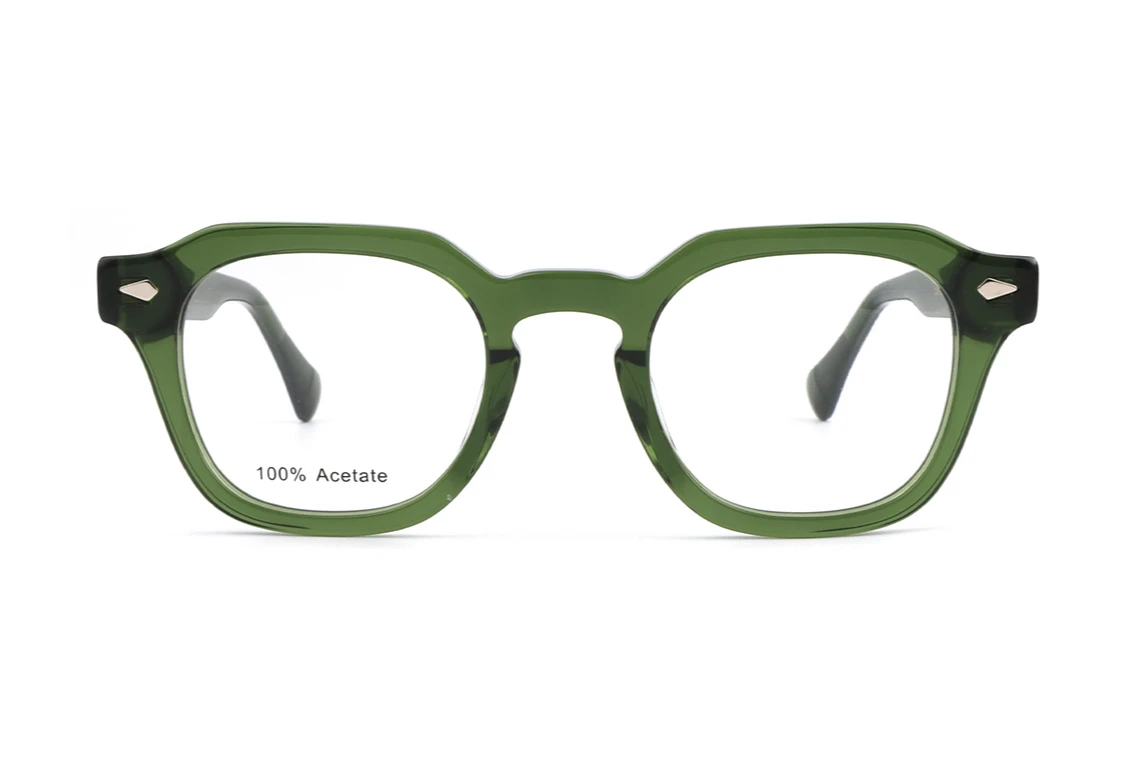
When inspecting an acetate frame, zoom in on the bridge and outer corners. Then compare the front view with an angled view. A transparent section may make an edge less obvious in one photograph, while the side view reveals its profile more clearly.
Do not infer the source of a frame's acetate from this general explanation. A product described as acetate is not automatically made with Mazzucchelli material. Likewise, a material name does not establish where the finished frame was manufactured.
What does a metal frame label tell you?
Metal is a broad category. A product record may name a more specific material, such as beta-titanium, while another record may simply say metal. Read the exact wording rather than assuming that all metal frames have the same composition.
The G.M.Surne G8642, for example, is listed as beta-titanium, with a 55□18-145 size marking. Those are catalogue specifications checked on 15 October 2026. They do not establish the composition of every hinge, screw, coating or other component.
A useful visual comparison focuses on the frame you can actually see. Is the upper rim prominent or fine? Does the bridge have a shape you like? Are the temples straight in profile or more sculpted near the hinge?
If you have a known sensitivity to a material, ask for manufacturer information about the relevant components. Do not decide from the metal label or finish colour alone. A silver-coloured finish is a colour description, not a full statement of composition.
What is TR90 in glasses frames?
TR90 is a label used for a type of polyamide material in eyewear. Polymer manufacturer EMS-GRIVORY describes Grilamid TR90 within its transparent-polyamide eyewear range. That source explains the material family; it does not certify the origin or performance of a separately listed retail frame.
The AIRLITE AL26002 is listed with a TR90 material specification and a 52□18-146 size marking. If that frame catches your eye, compare its front and temple shapes with the other candidates on your shortlist. Do not let a familiar material label replace that comparison.
A catalogue entry also needs to be read as a whole. Check whether the material description refers to the entire frame or only a major part of it. If the record does not say, keep that question open rather than filling the gap with a general claim from a material supplier.
Material and rim construction are different choices
Acetate, metal and TR90 are material descriptions. Full-rim, semi-rimless and rimless describe how the frame surrounds or supports the lenses. These are separate categories, so one label cannot substitute for the other.
For example, a preference for a finer-looking rim does not tell you which metal a frame uses. A preference for a full rim does not identify its polymer. Read the material field, look at the construction and check the product photographs together.
Lens suitability is a further question. ZEISS discusses matching frames with lens types, which is why a style shortlist should still be checked against your prescription and intended lenses by an eye-care professional. This article does not rank materials for a prescription.
How to compare the finished frames fairly
Write down the same information for each candidate. This avoids comparing a detailed specification for one frame with a general impression of another. A simple note can include material, size marking, total width if listed, bridge construction and the colour you are considering.
Next, separate what is known from what is missing. If one product lists a weight and another does not, you do not have a like-for-like weight comparison. If only one shows a side view, ask for more information before judging their profiles.
For fit, the Canadian Association of Optometrists' training outline identifies several considerations beyond material, including nose angles and temple fit. That supports a practical approach: compare the whole frame and arrange a fitting check, rather than choosing from a material ranking.
Colour can change your impression of the same outline too. Once you have a material and size shortlist, our clear versus black versus tortoiseshell comparison offers a way to compare that part of the design.
A materials checklist for BC shoppers
Your daily routine is a useful way to organise questions, whether you live in Burnaby, commute into Vancouver or work from home elsewhere in British Columbia. Describe that routine to the person helping you choose and fit the frame. It gives them something more concrete to work with than a request for the best material.
Before deciding, ask:
- What material does the manufacturer list for this particular style?
- Does that description cover the front, temples and other components?
- How does its size compare with my comfortable current pair?
- What fitting adjustments can a professional make to this construction?
- What care instructions apply to the frame and its finish?
- Is the frame suitable for the lenses I intend to use?
Keep care advice specific. For example, instructions for a bare material sample are not automatically the correct instructions for a finished frame with coatings, hinges and prescription lenses. Use the manufacturer's directions and ask your eye-care professional when something is unclear.
Choose from a shortlist, not a material league table
If a sculpted rim and patterned colour attract you, begin by exploring acetate examples. If a finer metal outline appeals to you, inspect the metal candidates and their named specifications. If you like a TR90 frame's design, compare it on the same dimensions and fitting questions as the others.
Then narrow the list to the frames you can describe clearly: the size, the bridge, the appearance and the unanswered questions. You can explore the frame catalogue with those checks in mind. A useful choice is one based on the actual frame, rather than a promise attached to a material category.
Prepared by GRAEL editorial. We compared the published product material labels and dimensions on 15 October 2026. They are catalogue specifications, not independent material tests. The cover is an AI-generated illustration; the in-article photograph shows the named product.
Questions
- Is acetate the same as TR90?
- No. Cellulose acetate and TR90 refer to different material families. Read the specific product record rather than treating every polymer frame as the same.
- Does a titanium label describe every frame component?
- Not necessarily. Ask what parts the material specification covers, including the front, temples, hinges and other components.
- Is there one best frame material for everyone?
- A material label cannot settle the choice. Compare the actual frame dimensions, construction, appearance, fitting options and suitability for the intended lenses.